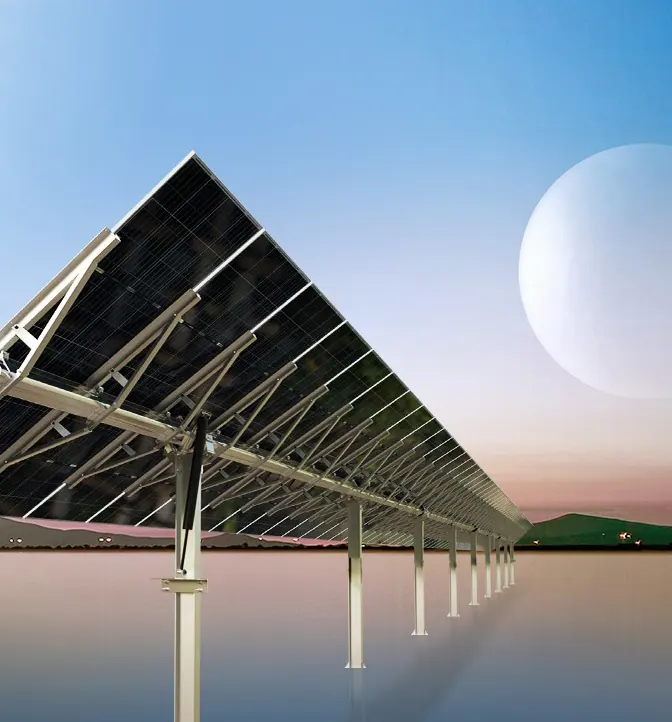
Answer first: the gain is real, and so is the scope it adds
A single-axis tracker raises annual energy yield by following the sun east to west, and the size of that gain is site-specific: it is largest at sunny, low-latitude locations with strong direct irradiance and materially smaller in cloudy, high-diffuse climates, so it has to come from a yield simulation on your own site rather than from a rule of thumb. In exchange it adds drives, controllers, a stow strategy, larger row spacing and a permanent maintenance obligation. Trackers therefore win where land is available, wind is moderate, the array is large and an operations team exists; fixed-tilt wins where any of those conditions fail.
This guide is a decision framework rather than a sales case. It covers where the gain comes from, what the tracker adds, when fixed-tilt is the better engineering answer, and what to send a supplier so both options can be compared on the same basis. For market context on tracker adoption, see the mounting and tracker market outlook.
Where the tracker gain comes from
Morning and afternoon, not midday
A fixed-tilt array is at its best for a short period around solar noon and loses cosine efficiency either side of it. A single-axis tracker rotates the module plane toward the sun through the day, so most of the gain is harvested in the morning and late afternoon. Two consequences follow. The production curve is flatter and wider, which can be worth more than the energy itself under time-of-use tariffs or a capacity-constrained connection. And the gain is largest where direct irradiance dominates; under heavy cloud the sky is diffuse and there is little directional advantage to capture.
Interaction with bifacial modules
Trackers and bifacial modules complement each other. Rotation exposes the rear surface to reflected and diffuse light through more of the day, and raised, single-post structures leave a relatively unobstructed ground view. The gains are not simply additive, and both depend on clearance, row pitch and ground albedo. The structural side of that decision is covered in the bifacial mounting guide.
What erodes the gain
Backtracking to avoid row-to-row shading at low sun angles, drive parasitic consumption, downtime, soiling, inverter clipping where the DC/AC ratio is high, and any curtailment or export limit all reduce the delivered advantage. A yield model that ignores backtracking and availability will overstate the benefit.
What a tracker adds to the project scope
The structural change is only part of the story. A tracker converts a static structure into a machine:
- A torque tube, bearings and dampers instead of fixed beams, with tighter foundation alignment tolerances along each row.
- A drive - the Apex single-axis tracker uses a slewing drive with a controller package on an IP65 control basis - working within a typical +/-60 degree tracking range.
- Control power and communications to every row, plus a control philosophy for night stow, cleaning, snow and wind events.
- A stow strategy with defined trigger thresholds and fail-safe behaviour when power or communications are lost.
- Wider row pitch to allow rotation without shading, which lowers ground coverage ratio and raises land, cabling and fencing quantities.
- Commissioning, spares and a maintenance plan for moving parts.
Fixed-tilt structures such as the Apex driven pile, ground screw and GT2 terrace systems carry none of that. They fix tilt in standard steps of 10, 15, 20, 25 and 30 degrees and are reviewed to a wind basis of up to about 60 m/s depending on terrain and configuration, with an adjustable-tilt option where seasonal repositioning by hand is practical.
Comparison at a glance
| Factor | Fixed-tilt ground structure | Single-axis tracker |
|---|---|---|
| Annual energy | Baseline | Higher; magnitude is site-specific, from simulation |
| Production shape | Peaked around solar noon | Flatter, wider morning and afternoon output |
| Moving parts | None | Drive, bearings, controller per row |
| Land per MW | Lower | Higher (rotation clearance) |
| Wind response | Fixed geometry, designed once | Stow strategy and control reliability critical |
| Terrain tolerance | Higher; steps and terraces workable | Lower; row alignment and slope limits apply |
| O&M scope | Structural inspection, cleaning | Adds mechanical, electrical and control maintenance |
| Availability risk | Very low | Row-level outage possible |
| Typical scale | Small to large | Medium to utility |
| Design tilt | 10-30 degrees in steps | Rotates within about +/-60 degrees |
When fixed-tilt is the better answer
**High-wind and cyclone-exposed sites.** Extreme wind is the classic case for fixed-tilt. A tracker's survival depends on reaching and holding a stow position, which depends on power, communications, control logic and mechanical response. A fixed structure's resistance is designed once and does not depend on an event sequence. In cyclone regions this is often decisive - see the high-wind and cyclone mounting guide.
**Small and medium arrays.** Controls, commissioning, training and spares are largely fixed costs. Below roughly a megawatt they are hard to justify, and the owner usually lacks a maintenance organisation for mechanical assets.
**Inexpensive land.** The tracker case is strongest when land is scarce and energy is valuable. Where land is cheap and available, adding fixed-tilt capacity is often a simpler route to the same annual energy than adding complexity to a smaller array.
**Heavy snow.** Snow accumulation, shedding behaviour and load on a rotating structure need careful review, and a higher fixed tilt can shed snow more predictably. The considerations are set out in the heavy-snow mounting guide.
**Difficult terrain.** Trackers impose limits on slope along the row and on foundation alignment. Stepped, undulating or terraced ground is usually easier and cheaper to serve with a terrace-type fixed structure.
**Weak grid, export limits or flat tariffs.** If output is curtailed, capped by connection capacity or paid at a flat rate, part of the tracker's advantage cannot be monetised.
When a tracker earns its keep
The favourable case is consistent: a utility or large commercial project, on reasonably flat land with adequate area, at a site with strong direct irradiance, a moderate wind climate, a grid connection able to absorb a wider production curve, and an owner or O&M contractor equipped to maintain rotating equipment. Under those conditions the extra energy is compounded over decades against a one-time cost increase, and the flatter generation profile can be worth as much as the extra kilowatt-hours.
The economics should be tested rather than assumed. Model both options with the same module, the same irradiance dataset, the same DC/AC ratio and realistic availability, then compare total installed cost including land, cabling, fencing and O&M. Small differences in land price, tariff structure or availability assumptions can flip the result.
Wind, stow and structural risk
Wind governs tracker engineering more than anything else. Three questions belong in every RFQ. What is the stow angle and at what wind speed is stow triggered? How long does the array take to reach stow, and what happens on loss of power or communications? What wind basis was the structure reviewed against, and in which position - operating, stowed or both?
Dynamic effects matter too. Long, torsionally flexible rows can respond to wind in ways a static calculation does not capture, which is why dampers, bearing design and row length limits appear in tracker specifications. The Apex tracker is reviewed to a wind basis of up to about 47 m/s, which is a review basis for a defined configuration rather than a universal rating - the same principle explained in the wind and snow load guide and in how to read a mounting datasheet.
Foundations also change. Tracker rows need consistent post alignment and plumb, so pile-driving tolerance and soil variability become a schedule risk. Confirming foundation choice against a soil report and pull-out testing is essential - the trade-offs are covered in ground screw vs driven pile.
Lifecycle, spares and availability
Over 25 years the difference is organisational as much as technical. A fixed-tilt array needs structural inspection, fastener checks, corrosion review and cleaning. A tracker adds drive and bearing inspection, controller and sensor maintenance, alignment checks after storms, firmware management and a spares inventory - and a failed drive means a row that stops tracking, so availability, response time and spare-part supply belong in the commercial evaluation. Corrosion protection should be specified against the real environment in both cases, as described in the corrosion protection guide.
Inputs for a like-for-like comparison
To compare a tracker and a fixed-tilt structure properly, send the site location and coordinates, the design wind and snow basis with terrain category, the available land boundary and topography, the module datasheet and target capacity, the inverter and DC/AC concept, any export or curtailment limit, the geotechnical data or pull-out results, and the intended O&M model.
Apex can then put a single-axis tracker and a comparable fixed-tilt ground structure against the same layout and load basis, so the comparison rests on the same assumptions. Datasheets for both are in the download centre, and the project data checklist lists everything needed for a review.
Frequently asked questions
How much extra energy does a single-axis tracker produce?
There is no single number, and any supplier who quotes one without seeing your site is guessing. The gain depends on latitude, the split between direct and diffuse irradiance, row pitch and the module type: sunny low-latitude sites with strong direct irradiance gain the most, while cloudy high-diffuse climates gain substantially less. The only figure worth putting in a financial model is the output of a site-specific yield simulation run with local irradiance data on both layouts - ask for the fixed-tilt and tracker simulations side by side and compare the annual energy, not a rule of thumb.
Do trackers need more land than fixed-tilt?
Usually yes for the same installed capacity. A tracker row needs clearance to rotate without shading its neighbour, so the ground coverage ratio is typically lower than a comparable fixed-tilt layout. Where land is scarce or expensive, that extra area can offset part of the energy gain.
Are trackers suitable for high-wind or cyclone-exposed sites?
They can be, but the stow strategy becomes the critical specification: the stow angle, the trigger wind speed, the time to reach stow and the behaviour on loss of power or communications. In severe wind regions many owners still prefer fixed-tilt because a structure with no moving parts has fewer failure modes under extreme load.
What maintenance does a tracker add?
Drives, bearings, fasteners, controllers, position sensors and any communications or power supply to the row all need periodic inspection. Practical additions are torque checks, bearing and drive inspection, alignment checks after extreme weather, firmware or controller management and spares stocking. Fixed-tilt maintenance is essentially structural inspection and cleaning.
Is a tracker worth it on a small commercial array?
Rarely. Fixed engineering, controls and commissioning costs do not scale down well, land use rises, and the operations burden lands on an owner without a maintenance organisation. Below roughly a megawatt, most owners are better served by a well-specified fixed-tilt structure and any saved budget spent on modules.
Can a fixed-tilt structure be upgraded to a tracker later?
Not realistically. The foundation layout, post height, row pitch and structural design differ, so a conversion means replacing nearly everything above ground and often the foundations too. If tracking is a possibility, design the layout and foundations for it from the start.
Prepare your project for Apex review
Send the project location, module datasheet, layout drawing, wind and snow basis, and roof or foundation condition for faster system selection.
Request Project Review