The bottleneck opens in New South Wales
Australia's utility-scale pipeline took a concrete step forward this week. EnergyCo, the New South Wales energy agency, has executed a Project Development Deed with transmission operator Transgrid to upgrade the grid between Jerilderie and Wagga Wagga — work that unlocks the capacity needed to connect 3.56 GW of wind, solar and battery storage in the state's South West Renewable Energy Zone. Source: PV Tech.
What the deed covers
The agreed scope centres on the Dinawan substation, whose operating voltage will be raised from 330 kV to 500 kV with a new switchyard added, alongside upgrades to 11 km of transmission line. Four generation and storage projects holding access rights under the South West REZ scheme can then connect to the National Electricity Market — including Origin Energy's Yanco Delta wind farm, Spark Renewables' Dinawan Energy Hub, Someva's Pottinger Energy Park and BayWa r.e.'s Bullawah Wind Farm. EnergyCo forecasts more than AUD 17.8 billion in private investment and an average of 1,690 direct construction jobs per year for the zone.
From grid milestone to structure demand
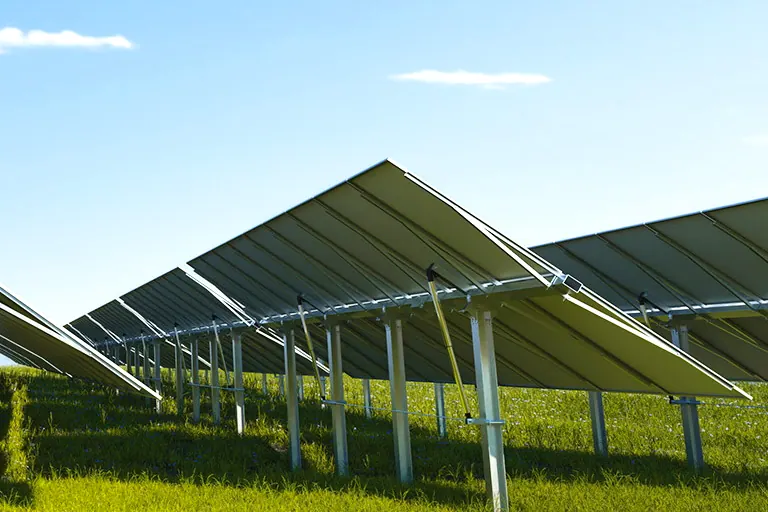
For the solar components of these hybrid projects, a transmission deed is the trigger that turns development-stage layouts into procurement. The Riverina's flat, open terrain is classic tracker country: single-axis trackers capture the wide morning-to-evening irradiance of inland NSW, while driven pile foundations suit the region's soils and install at the pace a gigawatt-class zone demands. Fixed-tilt ground mounting remains the simpler choice where layout constraints or budget favour it.
Designing for Australian conditions
Australian utility projects are specified to AS/NZS 1170.2, and inland NSW sites still see significant wind regions, dust and high summer temperatures. Structures need verified wind-load calculations, appropriate corrosion protection for agricultural environments, and hardware that tolerates large thermal cycles. Our guide to high-wind mounting design under AS/NZS explains what buyers should require from a supplier's documentation.
The takeaway
Renewable Energy Zones concentrate years of demand into defined regions, and the South West REZ has now moved from planning to delivery. Developers and EPCs preparing utility-scale bids in the zone can send Apex the site location, module format, layout and AS/NZS load basis — the engineering team will prepare a tracker or fixed-tilt structure package with documented calculations for review.
Prepare your project for Apex review
Send the project location, module datasheet, layout drawing, wind and snow basis, and roof or foundation condition for faster system selection.
Request Project Review