From pilots to scale
Agrivoltaics — generating solar power while keeping land in agricultural use — is entering its first true scale-up phase in Europe. Industry analyses report more than 2,800 dual-use installations now operating across some 20 countries, representing over 17 GW of planned or operational capacity, and estimate the global agrivoltaics market at around USD 5.8 billion in 2026 with strong double-digit growth projected through the 2030s. The signal for the supply chain is clear: dual-use is shifting from demonstration projects to a genuine market segment. Source: European Sustainable Energy Week.
Policy is driving the acceleration
The momentum is being shaped by dedicated support schemes. Germany's Solarpaket 1 sets aside special auctions for agri-PV and floating solar, reportedly targeting on the order of 1,200 MW in 2026, while Italy's national programme has aimed at roughly 1 GW and France runs dual-track auctions for elevated and interspace systems capped in the hundreds of megawatts per year. Countries including Spain and several in Central Europe are developing their own frameworks. These agriculture-first policies reward designs that genuinely keep the land productive.
Dual-use puts the structure first
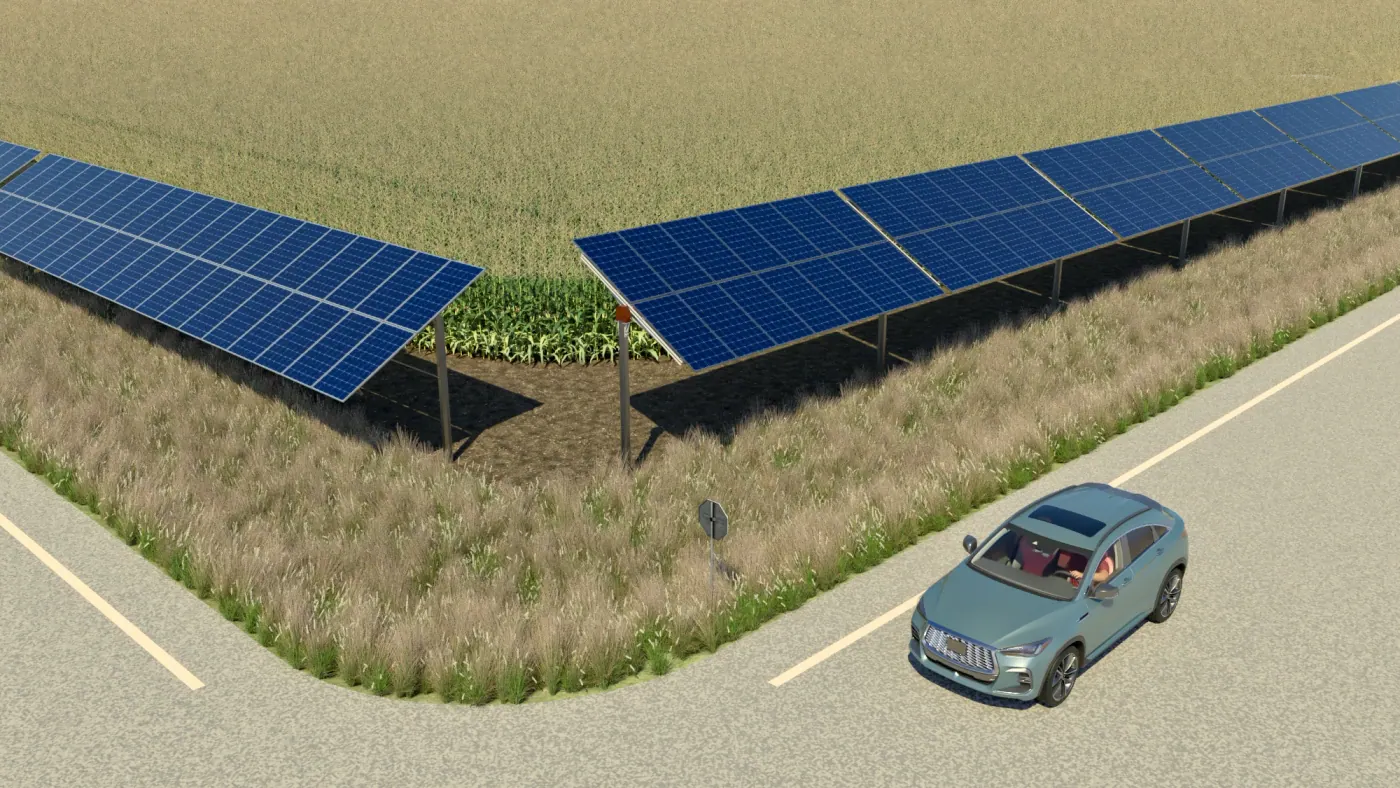
Because the field must stay farmable, the mounting structure leads the design rather than following the panel layout. Elevated high-clearance systems lift the array above machinery and crops, terrace structures follow sloping farmland, and vertical layouts leave wide clear strips for cultivation or grazing. Each approach trades generation density against farming access differently, which is why the ground structure choice is central to whether a project satisfies both energy and agricultural goals.
What developers should prepare
For a realistic dual-use structure, the farming plan sets the numbers: the crop or livestock, the machinery height and width that must pass underneath, the light the crop needs, and the site slope and soil. These inputs decide clearance, column spacing and foundation — the detail behind whether an agri-PV project passes agricultural review. Our agrivoltaic mounting guide covers the structural options in more depth.
Outlook
With policy support firming and a multi-gigawatt pipeline forming, agrivoltaics is likely to become a mainstream ground-mount category rather than a niche. To align a structure with a specific dual-use project, send Apex the land use, machinery clearance, target light or row spacing, slope and soil data, and the local load basis, and the team can propose a high-clearance, terrace or vertical configuration suited to the site.
Prepare your project for Apex review
Send the project location, module datasheet, layout drawing, wind and snow basis, and roof or foundation condition for faster system selection.
Request Project Review